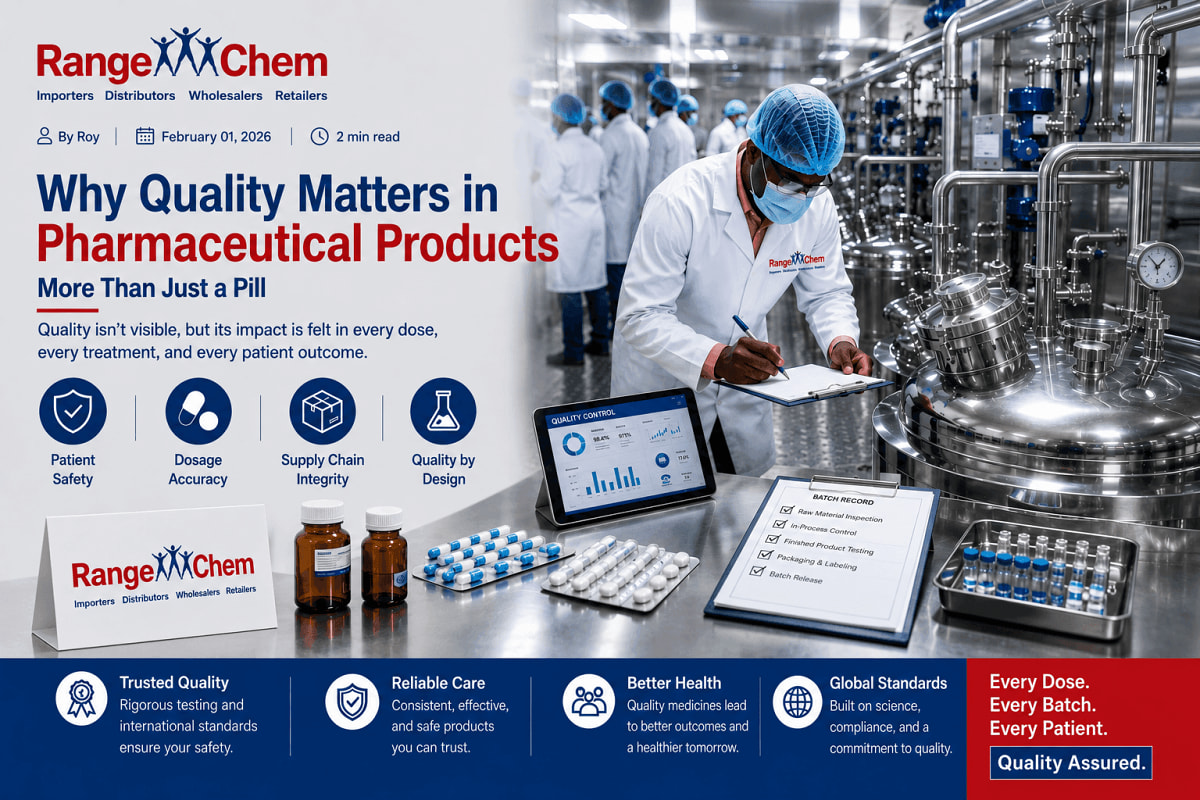
Why Quality Matters in Pharmaceutical Products: More Than Just a Pill
In the world of pharmaceuticals, the final product you hold—whether a box of tablets, a vial of injectables, or a bottle of syrup—is often indistinguishable from its competitors by sight alone. A white tablet looks like any other white tablet.
However, beneath the surface lies a complex scientific reality: Quality is invisible, but its absence is immediately felt.
For pharmaceutical companies, healthcare providers, and patients, "quality" is not just a buzzword or a regulatory checkbox. It is the invisible barrier between therapy and tragedy, between cure and complication. Here is why quality must remain the non-negotiable cornerstone of pharmaceutical manufacturing.
1. Patient Safety: The Primary Directive
The most obvious reason quality matters is patient safety. Contaminants, incorrect dosages, or impurities can turn life-saving medication into a life-threatening hazard.
- Impurities and Contaminants: Poor manufacturing processes can introduce harmful substances. The presence of unexpected impurities (like nitrosamines in blood pressure medications in recent years) demonstrates how a quality failure at the molecular level can lead to widespread health crises.
- Dosage Accuracy: If a blood thinner tablet contains slightly too much active ingredient, a patient could experience dangerous internal bleeding. If it contains too little, they risk a stroke. Quality assurance ensures that every single tablet, not just the average batch, contains the precise dosage required for therapeutic effect.
2. Efficacy: Will It Actually Work?
A medicine that is safe but ineffective is merely an expensive placebo. Quality control ensures that the drug performs as intended.
The bioavailability of a drug—how quickly and completely it is absorbed into the bloodstream—is heavily dependent on the manufacturing process. Factors like crystal structure of the active ingredient, compression force during tableting, and coating thickness can all affect how the drug dissolves in the body.
A high-quality product guarantees that the drug reaches the right part of the body at the right concentration, ensuring the patient actually gets better.
3. The Economics of Trust (For Manufacturers)
For pharmaceutical companies, quality is directly tied to the bottom line, but not just in terms of avoiding lawsuits. It is about Brand Equity.
- Recalls: A single quality lapse can result in a massive product recall. This destroys millions of dollars in inventory and supply chain efficiency.
- Regulatory Action: Regulatory bodies like the FDA (USA), EMA (Europe), or CDSCO (India) can shut down manufacturing plants for quality violations. This halts revenue and creates a supply shortage that damages relationships with healthcare providers.
- Market Credibility: Doctors prescribe medications based on trust. They need to know that a specific company’s drugs are reliable. Once that trust is broken by a quality scandal, it is nearly impossible to regain.
4. The Invisible Complexity: Supply Chains
Modern pharmaceuticals are global products. An active ingredient might be sourced from China, excipients from India, and packaging from Germany, before being assembled in the US.
Quality management must extend beyond the factory walls. Supply chain integrity is a massive component of quality. If a raw material supplier cuts corners, the final product fails. This is why pharmaceutical companies must audit their suppliers rigorously. Quality matters because it is the only way to ensure that a long, complex supply chain results in a consistent, safe product.
5. Fighting the Threat of Counterfeits
In a market where quality is low, counterfeits thrive. When patients and distributors cannot tell the difference between a high-quality pill and a fake one, they will buy the cheaper option.
By prioritizing quality—and making that quality known through certifications and reputation—legitimate pharmaceutical companies protect patients from the dangers of substandard or fake medicines that may contain toxic substances like floor wax or brick dust, which have tragically been found in counterfeit drugs in the past.
The Hidden Science: Quality by Design (QbD)
Modern pharmaceutical quality isn't just about testing the final product. It’s about Quality by Design (QbD) .
Instead of making a million tablets and then testing them to see if they are good, QbD means designing the manufacturing process to prevent errors from happening in the first place.
- Traditional Method: Make -> Test -> Hope.
- QbD Method: Design -> Control -> Ensure.
This proactive approach means that quality is baked into the product from the very first step of development, ensuring that variables like temperature, humidity, and raw material variations don't affect the final result.
Conclusion
In healthcare, we often talk about the "art of medicine," but the products we use are pure science. That science is only as good as the integrity of the manufacturing process.
When you choose a pharmaceutical product, you are not just choosing a chemical compound. You are choosing the sterile facilities, the rigorous testing protocols, the ethical sourcing, and the skilled scientists who ensured that the product in your hand will do exactly what it promises—without causing harm.
Quality matters because health matters.